AGENTIC ANNOUNCEMENTS
Universal Commerce Protocol (UCP) Explained: Beyond Google's Announcement

Maria Shimkovska
Content Engineer
Last updated: January 13, 2026
January 13, 2026
5 min read


Join thousands of developers building the future with Orkes.
Google’s Universal Commerce Protocol (UCP) could redefine how AI agents shop for us. Here’s what it is, how it works, and why it matters.
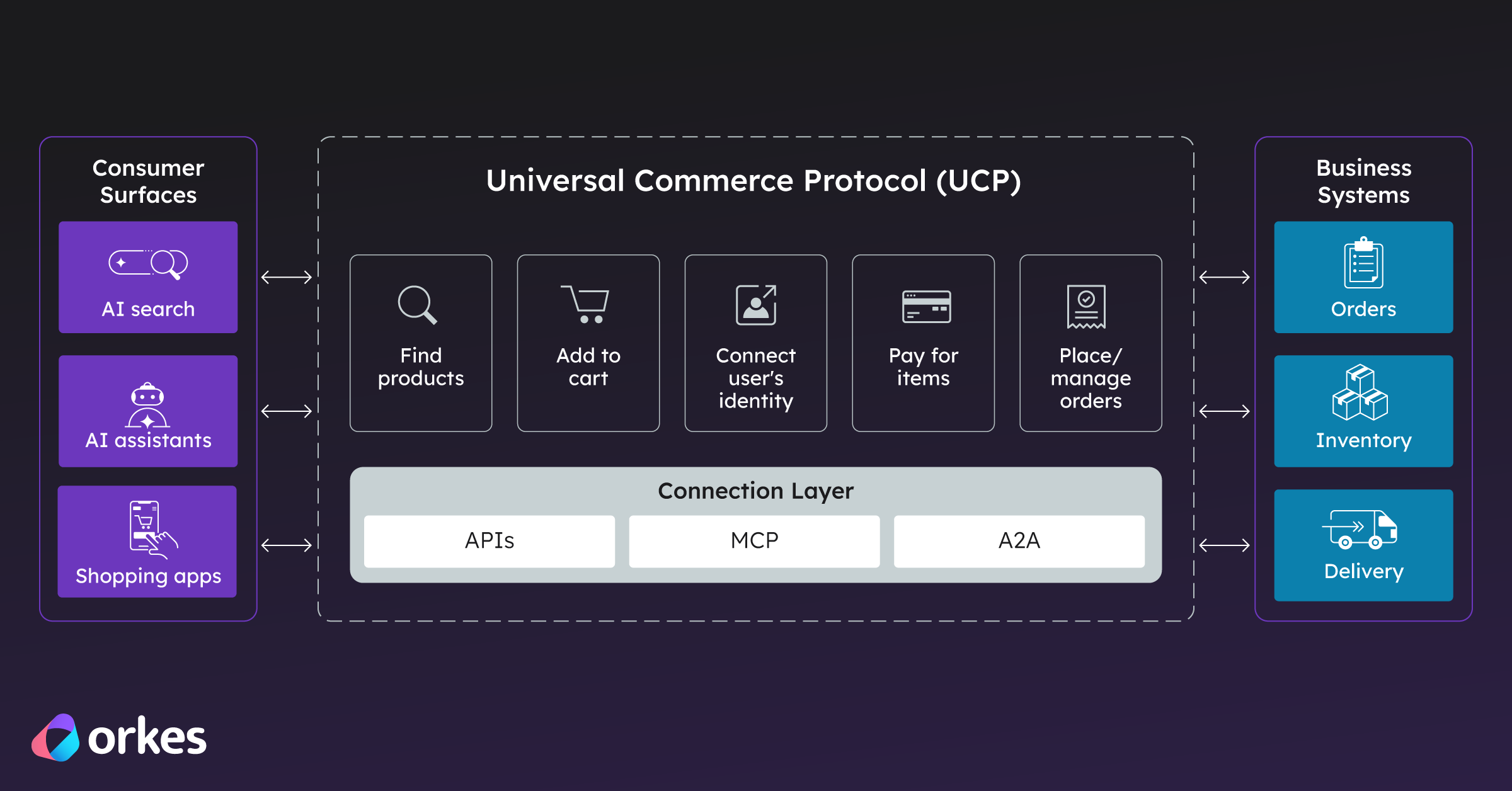
Google just introduced the Universal Commerce Protocol (UCP) in a recent article, which is a new protocol aimed at making agent-driven shopping actually work across platforms.
As I’m reading about it, it feels like a pretty huge deal for agentic systems and our future shopping experiences. The entire shopping industry might change drastically.
UCP gives AI agents a common way to discover products, start a checkout process, apply discounts, and work with different payment providers. All that without every business having to build a custom integration for every surface. It's a pretty big step forward for agentic commerce, like using tools for agents through MCP. Aka, your agent will be able to shop for you. 👀
It’s pretty much a common way for AI, people, and businesses to buy and sell things in agentic systems.
Every retailer has their own checkout system, every AI platform would need custom integrations with thousands of merchants, and payment providers all speak different languages. If AI agents are going to help us shop, they'd need custom connections to every store. This is pretty much a nightmare scenario that would never scale.
UCP seems to aim to change this by creating a single and open standard that everyone can use. Think of it like HTTP for the web or USB for devices, one protocol that just works everywhere. Similar to what MCP does for tool usage for agents.
UCP creates a common language between AI platforms, businesses, payment providers, and credential providers like Google Pay. Instead of building custom connections between every combination of these, everyone just implements UCP once and can work with the entire ecosystem.
The protocol covers the full shopping flow: product discovery, checkout with pricing and tax, payment processing, and post-purchase stuff like tracking and returns. All through standardized APIs that work the same across different merchants and platforms.
At a high level, this means you could buy something directly inside an AI chat, without being bounced across websites or checkout pages.
So you'd be chatting with an AI assistant and you could say something like "I need a lightweight suitcase for a trip next week." The assistant will then find a few options for you, check availability in real time, apply any discounts you may be eligible for, show you the final price, and let you pay right there in the conversation.
UCP does a great job defining what an agent can do during a commerce flow: discover a merchant's capabilities, create a checkout session, apply discounts, and choose a payment method. What it doesn't try to do is manage how all of that plays over time.
The key idea is this: UCP defines the contract, while Conductor manages the execution.
UCP says what a checkout can do, and Conductor ensures each step happens in the right order, handles failures, and waits when it needs to. One Reddit user actually mentioned if their AI agent spent thousands of dollars overnight on stuff they don’t need they will be sick. So as agentic shopping now enters our reality, we should make sure that doesn’t happen with pretty strict guardrails.
This isn't just a Google project. UCP was co-developed with major players including Shopify, Etsy, Wayfair, Target, and Walmart. Over 60 companies have endorsed it, including payment giants like Mastercard, Visa, American Express, PayPal, and Stripe, along with retailers like Best Buy, Macy's, and The Home Depot.
The diverse backing matters because it means UCP was designed to handle real-world commerce complexity.
The protocol launched just days ago, and Google is already using it to power a new checkout feature in AI Mode in Search and the Gemini app. When you're researching products, you'll soon be able to complete purchases directly using Google Pay or PayPal, without leaving the conversation.
For developers, the complete technical specification, SDKs, sample code, and even an interactive playground are available now on GitHub. The protocol is fully open-source and designed to be community-driven.
UCP represents a pretty fundamental shift in how we'll shop online. As AI assistants become more capable, they'll need standardized ways to interact with the commerce ecosystem.
Whether you're a developer, merchant, or consumer, UCP represents a significant shift in how online shopping might work going forward. The protocol for agentic commerce has arrived, and it'll be interesting to see how it plays out. Like any major change in how we buy things online, there are questions about what this means for the shopping experience, merchant relationships, and who controls what. It's definitely something to keep an eye on as it rolls out.
So far, the online discourse seems pretty negative on the idea of agents doing the actual shopping for people, but there was similar distrust with online shopping too. It will be interesting to see how this is addressed and how customer trust is gained for agentic shopping.
UCP is joining protocols like MCP (Model Context Protocol) and AP2 (Agent Payments Protocol), which makes you wonder if we're just getting started here. Commerce has a protocol now. Payments has one. Tool use has one.
It's interesting how all these protocols are popping up to make agentic systems actually work as a technology. Makes you curious what else is coming. These things move fast. We might see a bunch more before the year's out. If so, it will be interesting to do a protocol wrap up blog or ranking best to worst. 🤭